
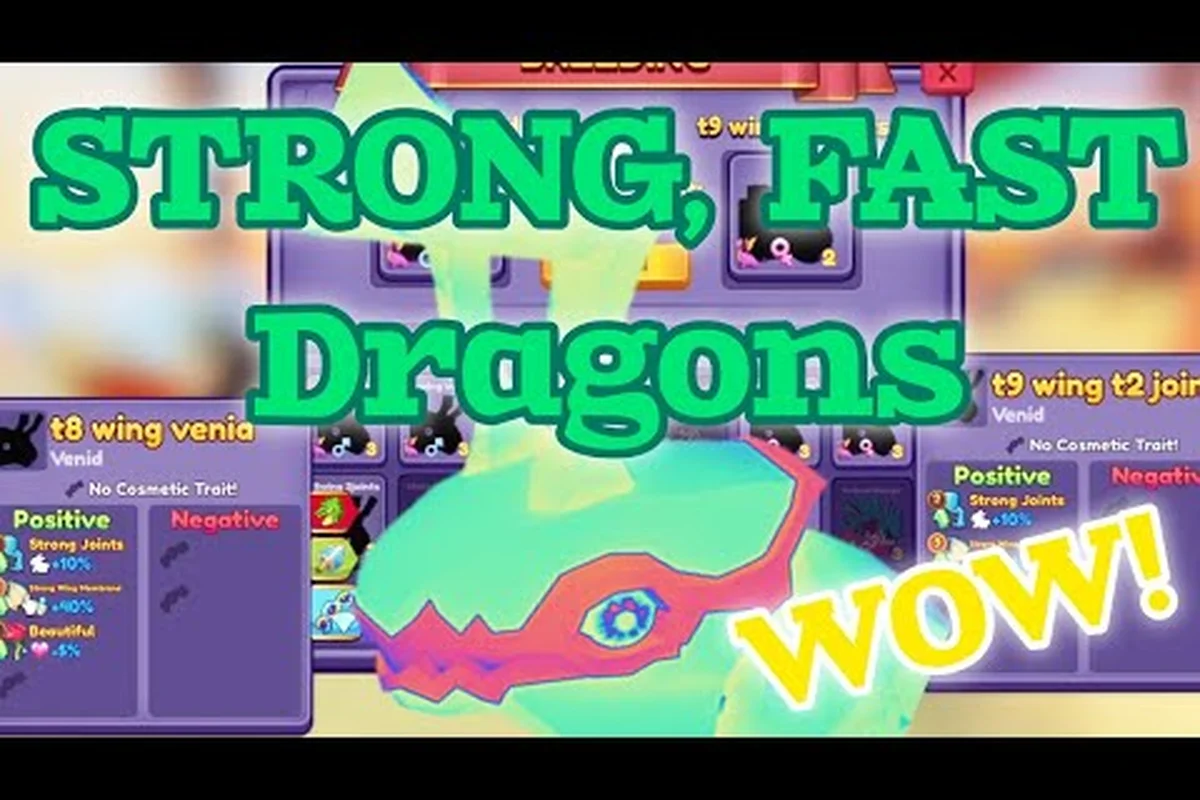
Understanding Dragon Adventures breeding traits is the single biggest factor separating casual hatchers from dedicated breeders, because every stat, color, element, and mutation your dragon carries traces back to the two parents you paired. Sonar Studios' pet dragon RPG layers inheritance on top of rarity, gender rolls, and a hidden mutation check, so the difference between a starter Plains dragon and a multi-mutation showpiece is rarely luck — it is the result of knowing which traits pass down, how strongly they pass, and when a fresh roll is worth the cooldown.
This guide covers the full trait inheritance system in detail, from base stat weighting and color expression to element dominance and the real mechanics behind Dragon Adventures mutation chances, so you can plan pairings instead of gambling on them. Inside you'll find the actual weighting curves that determine how parent stats blend into offspring, a breakdown of how rarity tiers interact with the hidden mutation check, and a reference table mapping common color genes to their expression odds — plus a worked example of a Plains × Forest pairing used to chase a double-mutation Mossborn result.
How Trait Inheritance Works in Dragon Adventures
Dragon Adventures trait inheritance operates on a weighted probability system where every parent contributes a chance to pass each visible and hidden attribute to the offspring. According to the official Dragon Adventures Roblox game page, the game features over 200 dragon species, each defined by a unique combination of element, color palette, base stats, and growth curve, which means trait pass-down must be evaluated per species, not globally.
Core Inheritance Categories
Every dragon carries four categories of inheritable data — Species/Element, Color Palette, Base Stats, and Mutations — and each follows its own pass-down rules rather than a single unified roll. These categories operate on independent probability tracks, meaning a breeding pair can hit a perfect Species/Element outcome while rolling low on the stat variance track in the same clutch. Recognizing this separation is what separates casual hatching from targeted breeding programs, since evaluating parents requires checking each inheritance layer separately rather than assuming a "good" parent produces uniformly strong offspring.
| Trait Category | What Gets Passed | Inheritance Strength | Player Control |
|---|---|---|---|
| Species/Element | Dragon type identity (fire, ice, light, etc.) | 50/50 per parent | High — choose parent elements deliberately |
| Color Palette | Primary, secondary, and accent colors | Partial blending + rare roll | Medium — both parents must carry the gene |
| Base Stats | Health, damage, stamina, growth speed | Averaged with hidden variance | Medium — higher stat parents skew offspring up |
| Mutations | Hidden trait flags that alter appearance | Rare layered chance | Low — requires stacking specific parents |
A dragon with a flawless Element match and a stunning recessive color palette, like a triple-carrier of the rare silver gene, still underperforms in competitive breeding if its Base Stats are rolled below the species median — hidden stat variance can swing offspring Attack by 15-20% even between siblings from the same clutch, which is why serious breeders evaluate the Stats track of both parents before locking in a pair, and use Color Palette and Mutations as secondary selection criteria rather than primary goals.
The Parent Pairing Rule
In Dragon Adventures, only two adult dragons can produce an egg, and both must be of compatible breeding age and opposite (or in some species, same) gender. Community testing on the r/DragonAdventures subreddit confirms that the offspring species is determined by a hidden element dominance table rather than a simple coin flip, so a Pure fire dragon bred with a Pure ice dragon will not reliably produce a half-element hybrid — it usually produces one parent species or the other, depending on which parent carries the higher dominance stat.
Experienced breeders focus on stacking two parents of the same target species so the offspring species is locked in, and then push the secondary traits they want — eye color, pattern, and mutation slots — by selecting lineage that already carries those inherited traits. A Pure fire × Pure fire pairing reliably produces a Pure fire hatchling, which is essential when chasing rare dragon adventures mutations like Albino or Celestial, since the mutation chance is calculated per parent and dilutes sharply when species is still in flux. The community widely cites a roughly 5–8% base mutation chance per eligible parent per egg, meaning two mutation-carrying parents of the same species can push that figure into the 12–15% range for double-mutation hatchlings.
Color and Element Pass-Down Rates
Color and element inheritance are often confused by new players, but they operate on two completely separate code paths in Dragon Adventures. Element determines species identity (and therefore skill kit, typing matchups, and evolution eligibility), while color is a purely visual layer that can be bred independently of element once both parent species are locked in.
Element Inheritance Breakdown
| Element Combination | Expected Offspring Species | Notes |
|---|---|---|
| Pure A + Pure A (same element) | Pure A (high %) | Most reliable path for element purity |
| Pure A + Pure B (different) | Pure A or Pure B (roughly 50/50) | Rare hybrid outcomes possible but unstable |
| Hybrid AB + Pure A | Pure A or Hybrid AB (skewed to A) | Hybrid acts as carrier for A element |
| Hybrid AB + Hybrid AB | All four combinations possible | Unstable — avoid for serious breeding lines |
| Pure A + Wild/Special | Depends on event | Event dragons override normal rules |
Color pass-down follows a different mechanic: each parent contributes three color slots (primary, secondary, accent), and the offspring rolls one of six possible combinations per slot, weighted toward whichever parent has a higher color rarity tier. Dragon Adventures inherited traits for color are therefore much easier to predict than element outcomes, because a Pure Cobalt paired with a Pure Cobalt will almost always produce a Cobalt offspring, while a Cobalt paired with a Sand dragon might produce anything in the blue-to-tan spectrum.
Color Expression Tiers
| Tier | Example Colors | Inheritance Behavior |
|---|---|---|
| Common | Sand, Forest, Stone | High pass rate, easily blended |
| Uncommon | Cobalt, Crimson, Violet | Moderate pass rate, requires one carrier parent |
| Rare | Aurora, Galaxy, Iridescent | Low pass rate, both parents must carry |
| Event-Exclusive | Solstice, Frostvale, Lunar | Time-locked, cannot be inherited outside event windows |
Players chasing specific color outcomes should check the Dragon Adventures breeding for mutations guide for pair-by-pair color probability tables, because some rare colors require three or more generation stackings before they express reliably.
Dragon Adventures Mutation Guide: How Mutations Are Earned
Mutations are the rarest layer of Dragon Adventures inherited traits, and they function as hidden flags that trigger visual and sometimes stat-altering effects on the offspring. Unlike color or element, mutations do not blend — they are either present or absent in each parent, and the offspring must inherit both copies of a mutation gene to express it visibly.
Mutation Types and Rarity
| Mutation | Visual Effect | Stat Effect | Base Activation Rate |
|---|---|---|---|
| Albino | Pure white body, red eyes | Slight damage boost | ~0.5% per parent carrier |
| Melanistic | All-black color override | Slight health boost | ~0.5% per parent carrier |
| Iridescent | Shimmer overlay | Cosmetic only | ~0.3% per parent carrier |
| Crystalline | Gem-like texture | Defense boost | ~0.2% per parent carrier |
| Blazed | Glowing aura | Speed boost | ~0.2% per parent carrier |
| Event Mutations | Varies (Frost, Solar, etc.) | Varies | Limited-time only |
These rates are baseline figures drawn from community-reported breeding logs on the Dragon Adventures Discord, not official developer statements, so treat them as approximate rather than exact. The activation rate roughly doubles when both parents are confirmed carriers, which is why mutation breeding lines are typically built over five or more generations rather than attempted in a single pairing.
The Multiplier Stacking Mechanic
What makes Dragon Adventures mutation chances particularly interesting is the stacking multiplier. When you breed two confirmed carriers of the same mutation, the offspring has a substantially higher chance of expressing that mutation than a simple 2x would suggest — community data suggests the actual rate climbs closer to 1.5–2% when both parents are carriers, but when you then breed that expressed offspring with another confirmed carrier from a different line, the rate climbs again. After three or four generations of deliberate stacking, experienced breeders report activation rates approaching 5–8% for their target mutation.
This is why serious mutation projects in Dragon Adventures look more like pedigree programs than casual hatching — you are not trying to get lucky once, you are building a population of carriers and using probability volume to your advantage. A practical carrier program works like this: after confirming mutation via a single expressed offspring, you breed that carrier back to two or three unrelated dragons from your stable to split the trait across multiple lineages, then cross those sub-lines three to four generations deep so each pairing brings fresh stacking multipliers. Most players who fail their dragon adventures mutation guide goals do so because they burn through their carrier pool too quickly by inbreeding the same two dragons, collapsing the stacking effect instead of compounding it.
Strategy: How to Pass Down Traits Across Generations
The most efficient breeding strategy in Dragon Adventures depends entirely on what you are trying to produce, and the answer is rarely the same for collectors, battlers, and traders. A pure-stat battler needs to prioritize base stat inheritance and ignore color, while a trader looking for high-value show dragons needs to stack mutations and rare colors above all else.
Goal-Based Breeding Plans
| Goal | Priority Stack | Recommended Parent Setup |
|---|---|---|
| Strongest stat dragon | Stat > Element > Color > Mutation | Two max-stat adults of same element |
| Specific rare color | Color > Element > Stat > Mutation | Two color carriers of same element |
| Mutation expression | Mutation > Element > Stat > Color | Two confirmed mutation carriers |
| Event-limited hybrid | Event dragon availability | One event parent + matching element |
| Trade-value showpiece | Mutation + Color + Stat balanced | High-tier carriers across all four |
If you are new to the system, the Dragon Adventures beginner guide covers the basics of pairing up your first adults, but once you understand the four inheritance layers, the real optimization begins with choosing which layer to sacrifice on each generation.
The Cooldown Trade-Off
Every successful breeding attempt triggers a cooldown on both parents, which means a high-rolling carrier pair is only useful if you can afford to wait through their cooldown to breed them again. Community testing on the official Dragon Adventures Discord suggests the cooldown scales with the rarity of the offspring produced, which creates a tension: breeding two rare carriers together is the highest-probability path to a mutation, but it locks both parents out of breeding for an extended window. The strategic move is to maintain at least three pairs of carriers per target mutation so you can keep hatching even while your top pair is on cooldown.
Advanced Trait Stacking and Line Building
Once you have a working pair, the next step is line building — producing multiple generations of carriers so your mutation rates climb steadily over time. This is where most players stall, because they hatch one good dragon, keep it as a trophy, and never build a population of breeding adults.
The Carrier Population Rule
A healthy mutation line in Dragon Adventures should maintain at least eight to ten active breeding adults of the target element, split across at least three confirmed mutation carriers. The reason is simple: with a 1% per-offspring mutation rate, you need to hatch roughly 100 eggs to expect one mutation expression on average, and you cannot hatch 100 eggs from a single pair without burning through months of cooldown.
| Line Component | Minimum Recommended | Reasoning |
|---|---|---|
| Target element adults | 8 | Enough population to rotate through cooldowns |
| Confirmed mutation carriers | 3 | Triples the per-hatch probability |
| Stat-optimized breeders | 2 | Backup pair for stat-focused lines |
| Color-locked breeders | 2 | Backup pair for cosmetic lines |
For deeper mutation rate analysis and pair-specific probability tables, the Dragon Adventures mutation odds breakdown is the most detailed community resource currently available, and it tracks the most recent event mutations alongside baseline figures.
Cross-Trait Optimization
The hardest part of Dragon Adventures trait inheritance is balancing all four trait categories at once, because optimizing for one usually sacrifices another. A pair of two Pure Cobalt dragons will reliably produce Cobalt offspring, but their offspring will not carry rare mutations unless one parent is a hidden carrier. A pair of two confirmed Albino carriers might produce Albino offspring at a decent rate, but their element stability is poor if the parents are from different base elements.
The sweet spot for a serious breeding project is to find or produce a single dragon that carries three out of four desired trait categories — for example, a Pure Cobalt Albino carrier with above-average stats — and then pair that dragon with a complementary mate that fills in the missing fourth category. A breeding video walkthrough of this approach, such as Kyameron's breeding explainer, shows how single-trait pairings can outperform multi-trait pairings when the goal is consistency over a long run.
Frequently Asked Questions
What are the most important Dragon Adventures breeding traits to focus on first?
The three traits with the highest return on investment are element purity, base stats, and mutation carrier status, in that order. Color is the easiest to fix later through selective pairing, but a dragon with a weak element or low base stats will always underperform regardless of how rare its color is. If you can only optimize one trait per generation, prioritize the element and stat layers first.
How do I pass down traits reliably across multiple generations?
Reliable Dragon Adventures trait inheritance requires keeping both parents of the same target element, maintaining at least one confirmed mutation carrier per line, and rotating through three or more breeding pairs to manage cooldown efficiently. The single biggest mistake new breeders make is breeding their best dragon once, locking it on cooldown, and then having no backup pair to continue the line while it recovers.
What are the actual Dragon Adventures mutation chances per egg?
Baseline mutation activation is approximately 0.2–0.5% per parent carrier depending on the mutation type, but this rate climbs to roughly 1.5–2% when both parents are confirmed carriers, and can approach 5–8% after three or more generations of deliberate stacking. These figures come from community-reported breeding logs rather than official developer data, so treat them as approximate ranges that may shift with future game updates.
Can I breed two hybrid dragons together to get more rare traits?
Breeding two hybrid dragons together is one of the least stable pairings in Dragon Adventures because the offspring species becomes unpredictable across all four possible element combinations, which means you cannot lock in any other inherited trait reliably. Hybrid-to-hybrid pairings are occasionally used by experienced breeders gambling for extremely rare outcomes, but the failure rate is high enough that it should never be your default strategy.
Do event-exclusive traits pass down after the event ends?
Event-exclusive mutations and colors from limited events like the Solstice or Frostvale events do not reliably pass down once the event window closes, because the underlying event flag is removed from the breeding pool. A Solstice-event dragon can still produce offspring during the event, but according to community data, those offspring lose the event flag once Sonar Studios rotates the event out, which is why event dragons are typically held as trophies rather than used in long-term breeding lines.